Are We Better With Breakfast? The evolution of breakfast recommendations from 1966 to 2026

Do you have a favorite meal of the day? Mine is breakfast! Breakfast is non-negotiable for me as well as its content.
When I plan my days, I account for when, where and how I will get and eat the necessary breakfast to start my day right. If I must get up extra early to catch a 6:00 am flight – I have a plan, staying in a high-rise hotel – I have a plan, or the varying schedule from day to day – I have a plan. I am better with breakfast and so are you!
The value of breakfast on our overall health and the trajectory of our days has been understood since World War I when the U.S. Government first initiated the concept of “better breakfast”. Later, in 1951, September was officially designated as “Better Breakfast Month” and continues to be celebrated now in 2026.
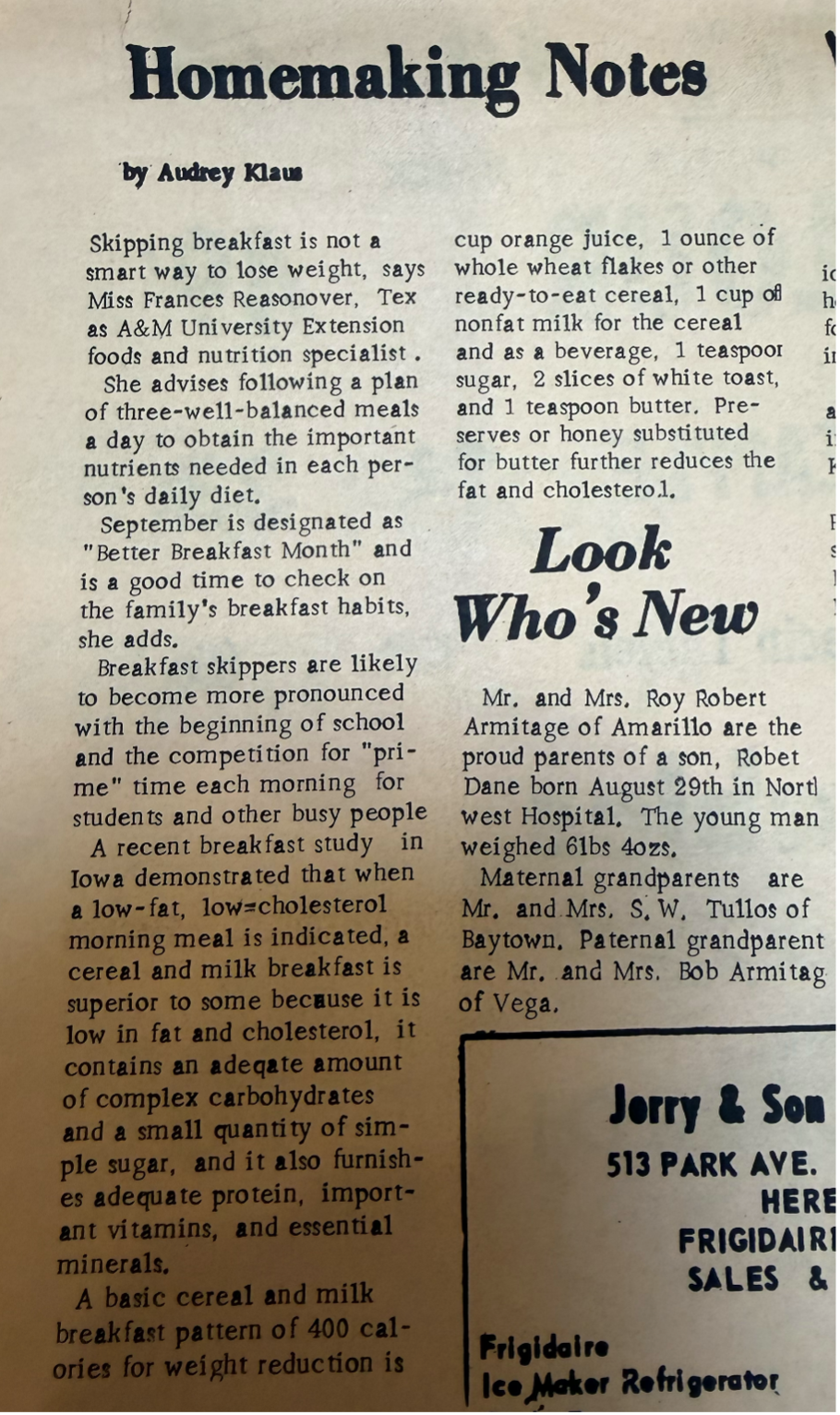
The definition of a “better breakfast” has evolved with the science over the past 60 years. Recently, a professional acquaintance shared a picture of a 1966 article from the Vega, Texas Newspaper that outlined what was considered a “Better Breakfast” at the time. There is a significant difference in the recommendation from then to now but the fact that skipping breakfast is “unwise” has stood the test of time.
Figure 1. Photo of an article published in the Vega Texas News Paper in September 1966. (complements of Dr. J.T. Whitehead).
Breakfast Recommendations shared in the article:
According to the 1966 article, “skipping breakfast is not a smart way to lose weight”. More specifically, it reported the Iowa Breakfast Study found a cereal and milk breakfast that is “[low in fat and cholesterol and contains adequate amount of complex carbohydrates], a small quantity of simple sugar, along with adequate protein, important vitamins, and essential minerals” to be superior.
To demonstrate how these recommendations can be met, the following breakfast menu was provided as an example (Figure 2).
Figure 2. 1966 Example Breakfast Menu was Described as “a basic cereal and milk breakfast pattern of 400 calories for weight reduction is:”

o Cup of orange juice o 1 ounce of whole wheat flakes (or other ready-to-eat cereal) o 1 cup of nonfat milk for the cereal and as beverage o 1 teaspoon of sugar o 2 slices of white toast o 1 teaspoon of butter (preserves or honey substituted for butter further reduces fat and cholesterol) |
How does this recommendation sound to you?
At first glance, it may not seem very different from what we consider a healthy breakfast is today. However, the understanding of some of these terms and ideas have shifted with compounding scientific evidence.
For instance, the amount of protein we should aim for and our recommendations on added sugars seemed noticeably different. My curiosity led me to enter this example breakfast menu into Cronometer Pro to see exactly what the nutrient composition was of this breakfast before making any further assumptions. The analysis is shown in Table 1.
Table 1. Nutritional analysis 1966 breakfast recommendation: (Cronometer Pro)
| Amount | AMDR |
Energy | 459.81 kcal |
|
Total Carbs | 86.34 g | 74 % |
Fiber | 4.80 g |
|
Total Sugars | 44.53 g |
|
Added Sugars | 4.16 g |
|
Total Fat | 5.79 g | 11.2 % |
Saturated Fat | 2.88 g |
|
Cholesterol | 18.42 mg |
|
Protein | 17.40 g | 14.8 % |
Leucine | 0.85 g |
|
To put these values into perspective, I considered the average female from the 1960’s who weighed ~140 lbs (~63.5 kg). The Recommended Daily Allowance (RDA) for protein is 0.8 g/ kg of body weight (BW). Multiplying 63.59 kg BW by 0.8 g/kg BW equals 50.8 g/day of protein to meet the RDA. Then, I divided 50.8 by three meals a day which results in roughly 16.93 g of protein per meal to meet the RDA.
The protein content of the 1966 breakfast did meet the RDA for protein which is defined as the amount of protein to meet the needs of most healthy individuals and prevent deficiency and chronic diseases.
The amount and types of protein necessary to optimize health; specifically, through preserving, repairing and building lean muscle mass, has been magnified through countless randomized controlled trials over the past 30 years. Now, the 2025-2030 Dietary Guidelines for Americans (DGA) reflects the protein research recommending 1.2 to 1.6 g protein/kg BW (USDA 2026) rather than the RDA.
Therefore, the average 1960’s female would have needed 25g to 34g protein per meal and ~76 g to ~102g of protein per day to optimize their health according to what we have learned from the science over the years. Table 2 compares protein recommendations from the RDA to the current DGA protein recommendations of various body weights.
Table 2. Comparison of protein recommendations of RDA to the DGA 2025-2030 guidelines of varying body weight (BW)
BW lb | BW kg | RDA | DGA 2025-2030 |
0.8 g/kg/day | 1.2 g/kg/day - 1.6 g/kg/day | ||
120 lb | 54.4 kg | 44 | 51 - 87 |
140 lb | 63.5 kg | 51 | 76 - 102 |
180 lb | 81.7 kg | 65 | 98 - 131 |
200 lb | 90.7 kg | 73 | 109 - 145 |
On a broader view, the Acceptable Macronutrient Distribution Range (AMDR) must be considered. The AMDRs are the percentage range of total calories from each macronutrient (carbohydrate, fat and protein) that is associated with decreased risk of chronic disease and micronutrient intake adequacy and are shown in Table 3.
Table 3. Acceptable Macronutrient Distribution Ranges (AMDRs)
Macronutrient | AMDR (% of energy) |
Fat | 20-35 |
Carbohydrate | 45-65 |
Protein | 10-35 |
In comparing the percentage of calories from each macronutrient in Table 1 to the AMDR in Table 3, we find that the 1966 breakfast recommendation was extremely high in carbohydrates and extremely low in fat falling outside of the AMRD ranges set in 1995. Therefore, the 1966 dietary recommendation was likely deficient in essential fatty acids and other micronutrients according to the definition of AMDRs.
1966 Breakfast Recommendations in Perspective:
What we deem as a “Better Breakfast” has undoubtedly changed over the past 60 years. Some things we got right, some things we got wrong, and some were simply based on the best evidence available at the time.
One thing that hasn't change is the necessity of breakfast to improve performance, maintain a healthy weight and improve overall health.
Now we focus more on optimizing protein, lowering carbohydrates; especially from added sugars and focusing on whole foods.
Figure 3 along with Table 4 outline two examples of breakfast that I would recommend to meet protein needs, reduce carbohydrate and focus on whole foods.
Option 1, Omelet with berries, is what I rely on when I am traveling and have access to a restaurant that has this option. Option 2, Cottage Berry Waffle, is a fun way to feel like you are still getting the comfort of a sweet treat breakfast that has the necessary protein to meet your needs.
Figure 3. Example Breakfast Menu to meet protein needs, reduce carbohydrate and focus on whole foods:
Option 1 | Option 2 |
Omelet with berries o 3 egg omelet with spinach, tomatoes, bacon and feta cheese o 1 cup of fresh berries  | Cottage Berry Waffle o 1 whole wheat toaster waffle o 1 Tbsp peanut butter (or other nut butter) o 1 cup cottage cheese o 1 cup frozen strawberries or other berries  |
Table 4. Nutritional analysis 2026 breakfast recommendation – Example recipes: (Cronometer Pro)
| Omelet & berries | Cottage Berry Waffle |
Energy | 447.11 kcal | 379.09 kcal |
Total Carbs | 48.22 g | 21.98 g |
Fiber | 7.11 g | 4.59 g |
Total Sugars | 22.47 g | 13.19 g |
Added Sugars | 2.86 g | 0.14 g |
Total Fat | 16.39 g | 21.75 g |
Saturated Fat | 4.88 g | 7.07 g |
Cholesterol | 30.55 mg | 536.72 mg |
Protein | 30.55 g | 29.51 g |
Leucine | 2.24 g | 2.59 g |
Nutrition science has greatly evolved in the past 60 years, and there is still more to learn and discover. Sound, unbiased, randomized control trials are essential to continue understanding the effects of nutrition on health, performance and longevity.
Sometimes it is difficult for scientists to change their recommendations when new evidence proves previous beliefs incorrect. This is a human issue, and we must be willing to continually question what we think we know, follow the evidence, and change our minds when better evidence becomes available to expand our understanding.
Sixty years from now, there is a chance science will have further evolved, and the breakfast recommendations may look a little different. However, the fact will surely stand firm that WE ARE BETTER WITH BREAKFAST!

Comments